01Roots in the Real
There is a moment near the beginning of Karel Reisz's Saturday Night and Sunday Morning (1960) when Albert Finney, lathe-operator and habitual troublemaker, stares down from a factory gantry at the floor below and the camera simply watches him. No swell of music, no editorialising close-up. Just a man, a machine, and the particular exhaustion of a Monday morning. It is as if British cinema suddenly decided to trust its own eyes.
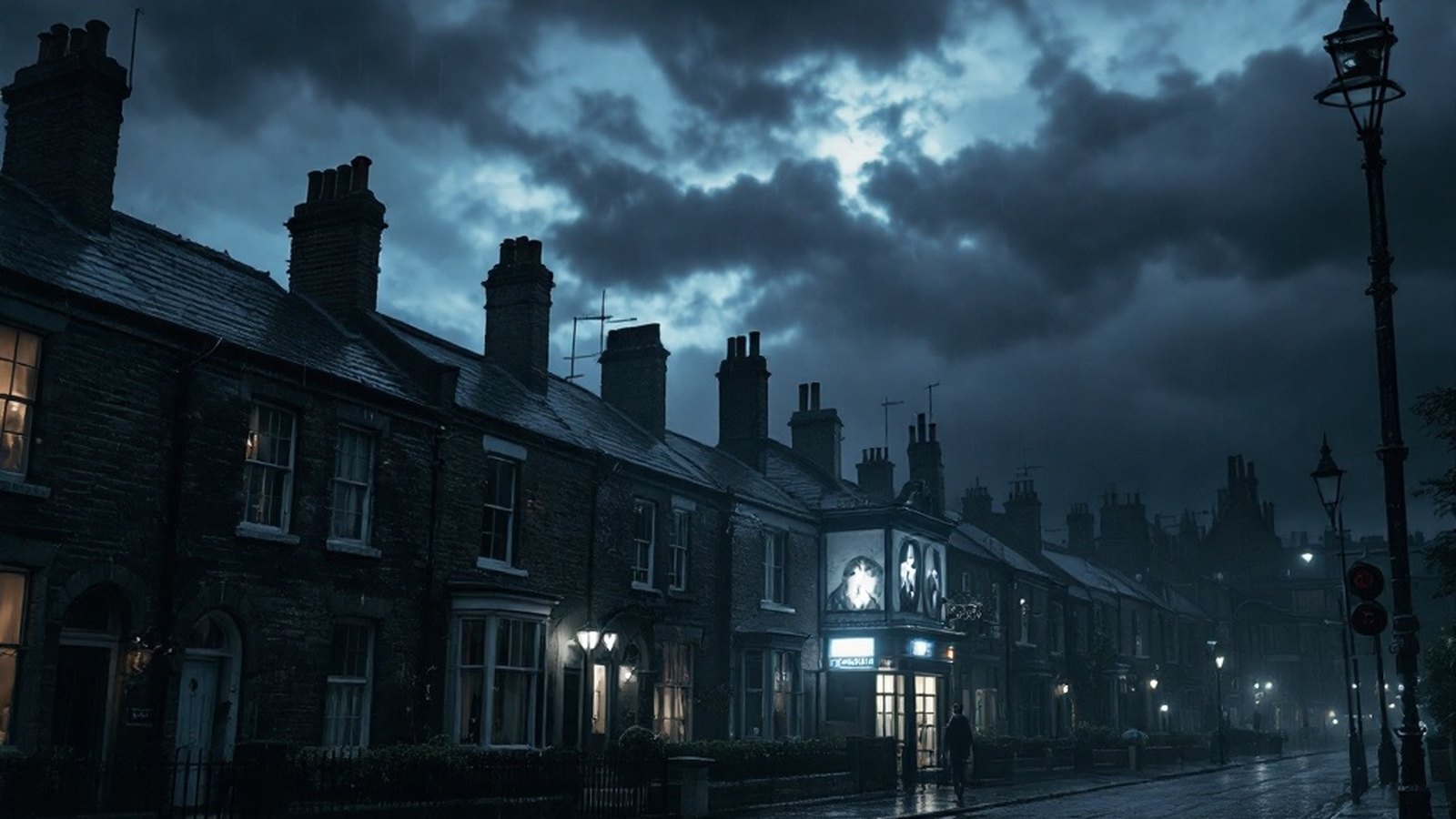
The kitchen-sink drama — the label borrowed from a John Bratby painting, then flipped into a term of mild mockery before being reclaimed with pride — arrived in the late 1950s on the back of a wider restlessness. John Osborne's Look Back in Anger had lit the fuse on stage in 1956; the Free Cinema movement, spearheaded by Lindsay Anderson, Karel Reisz and Tony Richardson at the National Film Theatre, was already making poetic short documentaries about fairgrounds, steelworkers and jazz clubs. The feature films that followed — Tony Richardson's A Taste of Honey (1961), John Schlesinger's A Kind of Loving (1962), Reisz's Saturday Night — extended that impulse into narrative. They shot on location in Nottingham, Salford and Bradford. They cast actors whose accents had never been heard in British films before. They let the streets look like streets.
What distinguished this wave from mere grimness was its ambivalence. These films did not condescend to their characters or sentimentalise their predicaments. Arthur Seaton wants pleasure and resents the cost of it. Jo in A Taste of Honey wants love and won't perform gratitude for receiving it. The moral texture was thick, the conclusions unresolved. That combination — realism of surface, complexity of feeling — would prove to be the tradition's lasting gift.
The label "kitchen sink" began as mild mockery — borrowed from a John Bratby painting — before the film-makers reclaimed it with pride.
The lives usually edited out of public culture are worth the full, patient, formally serious treatment cinema can provide.
02Loach and the Long Argument
No filmmaker has occupied this tradition longer, or pressed harder on its implications, than Ken Loach. His television work of the 1960s — Cathy Come Home (1966), directed for the BBC's Wednesday Play strand and watched by an estimated twelve million people — was the moment British social realism became publicly scandalous in the best sense: it changed minds and briefly shifted policy discussion about housing. Loach and producer Tony Garnett understood that realism was not merely an aesthetic option but a political act, a decision about whose life was worth a film.
His features — from Kes (1969), still perhaps the most quietly devastating British film ever made, through Riff-Raff (1991), Ladybird Ladybird (1994) and The Full Monty-era counter-programming of My Name Is Joe (1998), to the two Palme d'Or winners The Wind That Shakes the Barley (2006) and I, Daniel Blake (2016) — form an argument sustained across more than half a century. The argument is simple in outline and immensely complicated in execution: that social structures damage people, and that the damage is not inevitable, and that depicting it with clarity is a form of solidarity. His method evolved only slightly over the decades. The non-professional or semi-professional cast. The withheld script, with actors sometimes discovering narrative information only as the camera rolls. The refusal of cosmetic lighting. The patience to let a scene find its own rhythm.
I, Daniel Blake polarised critics — some found it didactic, and that charge is not entirely wrong — but the question the film posed was real: what does a welfare system do to the person caught inside it? The fact that the film made audiences weep in multiplexes as well as independent screens suggested the tradition had not lost its reach.
Loach is not the only name on the register. Mike Leigh arrived slightly later, developing his distinctive rehearsal method — in which actors build characters and relationships over weeks before improvising scenes that Leigh then scripted — to produce Meantime (1983), High Hopes (1988) and the career peak of All or Nothing (2002). Where Loach insists on structure as the villain, Leigh tends to locate the drama inside families, inside the gap between what people say and what they feel. Secrets & Lies (1996) won the Palme d'Or at Cannes and remains one of the finest British films of the decade: a room-temperature domestic explosion that is almost unbearable by its end. Both directors are working the same allotment from different corners.
03The Inheritance: Arnold, Meadows and the Next Generation
The question with any tradition is whether it calcifies or transforms. British social realism has, on the whole, transformed — partly because the filmmakers who inherited it brought genuinely different preoccupations and, crucially, different formal instincts.
Andrea Arnold is the clearest case. Her debut feature Red Road (2006), shot in Glasgow and part of the Advance Party project that saw three directors work from the same characters, announced a filmmaker who had absorbed the tradition's ethical commitments while finding a new visual language for them. The close-focus, shallow-depth handheld work — skin pores, breath in cold air, peripheral blur — created an intimacy that felt almost intrusive, which was precisely the point for a film about surveillance and grief. Fish Tank (2009) pushed further: a single mother and her fifteen-year-old daughter on an Essex estate, and a performance from Katie Jarvis, cast after being spotted arguing on a railway platform, that remains among the finest in contemporary British cinema. The Loachian method of finding performance in lived experience was still present, but Arnold charged it with a visual restlessness and a frank attention to female desire that had not always been part of the inheritance.
Shane Meadows, working largely from and about the Midlands, brought a related intensity. This Is England (2006), drawing on Meadows's own childhood in the early 1980s, gave British social realism skinhead boots and a National Front flag and used period detail not as nostalgia but as a way of asking how ordinary boys get recruited into hatred. The film's television sequels extended the story into the late 1980s with a cumulative force that no single film could have achieved. Clio Barnard's The Selfish Giant (2013), loosely from a Wilde story and set in Bradford, proved that the mode could accommodate a kind of fable-like heightening without losing its grounding.
What these filmmakers share is a trust in place. The estate, the post-industrial town, the commuter-belt flat — these are not backdrops but active presences. British social realism has always known that where you live shapes who you can be, and that cinema is unusually good at capturing the specific weight of a specific location. Cinematographers like Robbie Ryan, who shot for Arnold and for numerous British independents before his work broadened internationally, understood this instinctively: the light in Essex is not the light in Glasgow, and the difference matters.
- Late 1950sFree Cinema movement; kitchen-sink drama emerges on stage and screen
- 1960–62Saturday Night and Sunday Morning, A Taste of Honey, A Kind of Loving released
- 1966Cathy Come Home broadcast; shifts public debate on homelessness
- 1969Kes released; becomes cornerstone of the tradition
- 1996Secrets & Lies wins Palme d'Or at Cannes
- 2006Red Road, This Is England, The Wind That Shakes the Barley all released
- 2009Fish Tank wins BAFTA and establishes Arnold as a major filmmaker
- 2016I, Daniel Blake wins second Palme d'Or for Loach
| Ken Loach | Mike Leigh | |
|---|---|---|
| The villain | Social structures — the system that damages people | The family — the gap between what people say and feel |
| Method | Withheld script; non-professional cast discover the story as the camera rolls | Weeks of rehearsal and improvisation, then scripted from what the actors build |
| The room | Housing offices, picket lines, the welfare queue | The kitchen table, the front parlour, the family gathering |
| Landmark | Kes (1969); I, Daniel Blake (2016) | Secrets & Lies (1996); All or Nothing (2002) |
| Film | Director | Year |
|---|---|---|
| Saturday Night and Sunday Morning | Karel Reisz | 1960 |
| A Taste of Honey | Tony Richardson | 1961 |
| Kes | Ken Loach | 1969 |
| Secrets & Lies | Mike Leigh | 1996 |
| Red Road | Andrea Arnold | 2006 |
| This Is England | Shane Meadows | 2006 |
| Fish Tank | Andrea Arnold | 2009 |
| I, Daniel Blake | Ken Loach | 2016 |
04Why It Endures
The pessimistic reading of British social realism's durability is that it keeps being relevant because British society keeps producing the same injuries — poverty, bad housing, precarious work, children failed by institutions. There is something to that. The optimistic reading is that the tradition endures because it found a form adequate to its subject and keeps finding filmmakers capable of renewing it.
Both readings are probably true. The funding challenges that beset British independent cinema make films like these harder to get made — lower budgets, narrower distribution windows, streaming platforms that may acquire but rarely champion — yet they continue to get made. The British Film Institute's support for first and second features, alongside National Lottery funding, has kept the pipeline open, if narrow.
What the kitchen-sink tradition ultimately offers is not misery but attention: the insistence that the lives usually edited out of public culture are worth the full, patient, formally serious treatment that cinema can provide. From Finney on that factory gantry to Jarvis on that estate, the camera keeps saying: this person, this place, this life. Look. That instruction, unglamorous and uncompromising, has proved difficult to exhaust.
The names to know
Ken Loach
British director; the tradition's most sustained and politically committed practitioner
Andrea Arnold
British director; renewed social realism with a new visual and feminist sensibility
Karel Reisz
Czech-born British director; key figure in the Free Cinema and kitchen-sink movements
Tony Richardson
British director; A Taste of Honey and The Loneliness of the Long Distance Runner
Mike Leigh
British director; developed distinctive rehearsal/improvisation method for social drama
Shane Meadows
British director; This Is England and its TV sequels set in the Midlands